Malawi is among six African countries set to benefit from a €100 million (about K208 billion) four-year European Union (EU) Regional Responses to Climate Displacement Programme to build resilience against the impact of climate-induced displacement.
EU Ambassador Daniel Aristi-Gaztelumendi said at the launch of the programme in Lilongwe yesterday that other beneficiary countries are Mozambique, Madagascar, Comoros, Mauritius and Seychelles.

He said Malawi is the lead country for the regional coordination programme and will receive 17 million euro (about K34 billion) to support efforts aimed at minimising climate displacements.
Aristi-Gaztelumendi said in anticipation of El Niño weather phenomenon, the EU is intensifying early warning systems while pre-positioning response efforts so that the country can prepare and respond accordingly.
“It is a big project. We are talking about two regional clusters. The second cluster is the one we are talking about here. Malawi leads and it is Malawi, Mozambique, Madagascar, Mauritius, Comoros and Seychelles. We have almost €50 million in this second cluster, €17 million exclusively for Malawi to address the issue of climate displacement,” he said.
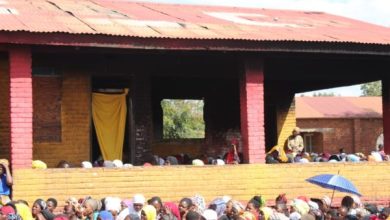
Meanwhile, International Organisation of Migration (IOM) Malawi has said its displacement report shows that 45 000 households remain internally displaced, with some still living in camps and looking to restart their lives after climate-induced displacement.
IOM chief of mission to Malawi Fatma Said said many of the displaced people have expressed willingness to relocate to higher ground and other safer areas where they can rebuild their lives after climate-related shocks.
She said based on the pattern of destructive disasters that have affected the country in recent years, Malawi experiences a major disaster roughly every four years.
Said, therefore, called on stakeholders to plan properly, especially as warnings point to possible El Niño impacts that could affect the country.
“Our area of focus is basically helping them to go back to the areas where they were left involuntary. They did not intend to live in the first place. From our data as of May, about 45 000 were displaced in Malawi,” she said.
One of the displaced persons, Modester Stonkeni from Chantulo Village in Traditional Authority Namkumba in Mangochi, said she will never forget the day her village was flooded in the middle of March this year.
Recounting the circumstances that led to her displacement, she said heavy rains fell non-stop for more than two days accompanied by strong winds which her house could not withstand.
“We are living in our relatives’ places. We do not want to go back to that place because our houses were brought down and are not habitable,” said Stonkeni.
Minister of Natural Resources Patricia Wiskes said it is worrying that many displaced people have yet to relocate to safer places and restart their lives in the aftermath of the floods.
“We have learnt with concern today that most of the families that were displaced during the disaster in March have still not settled; some are still in camps and as government, [we] would love to see these people get back on their feet and begin to [rebuild] and move forward with their lives,” she said.
The project is being implemented in Blantyre, Chikwawa, Nsanje, Mangochi, Phalombe, Mulanje and Dowa districts.
Southern Africa remains highly exposed to cyclones, floods and droughts, with more than 826 000 displacement movements recorded during the 2024–2025 cyclone season.
In 2025, sub-Saharan Africa recorded 17.3 million internal displacements, including 2.9 million linked to disasters.
For five consecutive years, Malawi has experienced climate-induced disasters, including Cyclone Idai, Cyclone Gombe, Tropical Storm Ana, Cyclone Freddy and more recently El Niño, placing the country among the world’s most vulnerable nations to climate change.
These disasters have resulted in significant economic losses from which recovery will take time, with the Department of Disaster Management Affairs estimating losses at K2.5 trillion.